
FBAR vs. FATCA: What's the Difference and Do You Need to File?
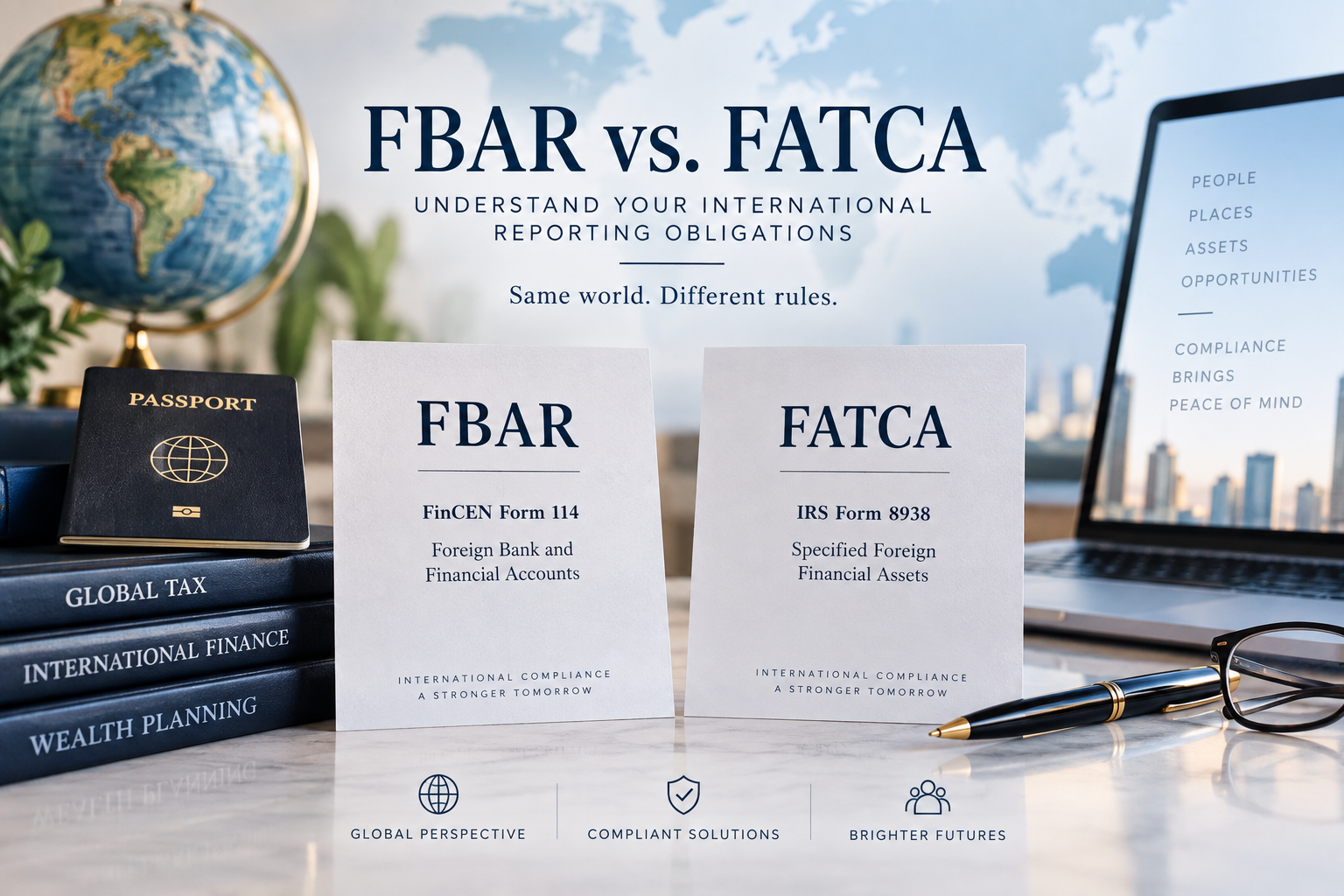
FBAR vs FATCA comparison for U.S. taxpayers with foreign financial accounts and international reporting obligations.
Many U.S. taxpayers with foreign financial accounts are surprised to learn that they may have international reporting obligations, even if they owe no additional U.S. tax.
Two of the most common reporting requirements are:
FBAR (FinCEN Form 114)
FATCA (IRS Form 8938)
Although these forms often apply to the same individuals, they are completely separate reporting requirements, are filed with different government agencies, and have different filing thresholds.
Understanding the difference is essential because the penalties for failing to file can be significant.
What is FBAR?
FBAR stands for Report of Foreign Bank and Financial Accounts.
It is filed electronically with the Financial Crimes Enforcement Network (FinCEN), which is part of the U.S. Department of the Treasury.
The purpose of FBAR is to report foreign financial accounts held by U.S. persons.
Who Must File an FBAR?
Generally, you must file an FBAR if:
You are a U.S. citizen, resident, or certain entities; and
The combined maximum value of all your foreign financial accounts exceeded $10,000 at any point during the calendar year.
This threshold is not per account—it applies to the aggregate value of all foreign accounts combined.
What Counts as a Foreign Financial Account?
Examples include:
Foreign bank accounts
Savings accounts
Checking accounts
Fixed deposits
Foreign brokerage accounts
Certain retirement or investment accounts
Mutual fund accounts
Accounts over which you have signature authority (even if you do not own the funds)
What is FATCA?
FATCA stands for the Foreign Account Tax Compliance Act.
Unlike FBAR, FATCA reporting is completed on IRS Form 8938 and is filed with your federal income tax return.
The purpose is to disclose specified foreign financial assets to the IRS.
Who Must File Form 8938?
FATCA filing requirements depend on several factors, including:
- Your filing status
- Whether you live in the United States or abroad
- The total value of your specified foreign financial assets
For taxpayers living in the United States, the most common filing thresholds are:
| Filing Status | File Form 8938 If Foreign Assets Exceed |
|---|---|
| Single or Married Filing Separately |
$50,000 on the last day of the tax year
OR $75,000 at any time during the tax year |
| Married Filing Jointly |
$100,000 on the last day of the tax year
OR $150,000 at any time during the tax year |
Note: Higher filing thresholds generally apply to taxpayers who qualify as living outside the United States under the FATCA rules.
FBAR vs. FATCA: Side-by-Side Comparison
Can You Have to File Both?
Yes.
Many taxpayers are required to file both FBAR and FATCA.
For example:
You are a U.S. resident.
You have three bank accounts in India with a combined maximum balance of $125,000.
In this situation:
The combined account balance exceeds the FBAR threshold.
Your foreign assets may also exceed the FATCA reporting threshold, depending on your filing status.
Because the two forms are filed with different agencies, filing one does not satisfy the requirement to file the other.
Common Misconceptions
"The account doesn't earn interest."
Income is not what determines whether reporting is required. Even accounts that generate little or no income may need to be reported.
"The money was inherited."
Inherited funds or accounts may still be reportable if they are held in foreign financial accounts.
"The account is joint with my spouse."
Joint ownership does not automatically eliminate the filing requirement. Many jointly owned foreign accounts must still be reported.
"I already reported the income."
Reporting the income on your tax return is separate from reporting the existence of the account.
What Happens if You Forget to File?
The IRS and FinCEN have authority to impose substantial penalties for failure to comply with international reporting requirements.
In many situations, taxpayers who discover they have missed prior-year filings may be able to become compliant through available IRS procedures, depending on their specific circumstances.
Because the rules are complex, it is generally advisable to address missed filings promptly rather than waiting for the issue to arise during an examination.
What Information Will You Need?
Preparing FBAR or FATCA filings generally requires:
Foreign bank names
Account numbers
Maximum account balances during the year
Country where each account is located
Ownership information (individual or joint)
Year-end statements or transaction history
Currency conversion information
How Yogideri Financial Solutions Can Help
International reporting requirements can be confusing, especially if you have accounts in countries such as India or inherited overseas assets.
At Yogideri Financial Solutions, we assist clients with:
Determining whether FBAR or FATCA filing is required
Preparing and electronically filing FBARs
Preparing IRS Form 8938
Reviewing prior-year compliance
Coordinating international reporting with your federal income tax return
Answering questions about foreign accounts, inherited assets, and reporting obligations
Whether you're filing for the first time or catching up on missed filings, we can help guide you through the process with confidence.
Not Sure Whether FBAR or FATCA Applies to You?
International reporting rules can be confusing, but they don't have to be.
At Yogideri Financial Solutions, we help individuals and business owners determine whether FBAR, FATCA, or both are required, prepare the necessary filings, and assist with prior-year compliance.
Schedule a Consultation